









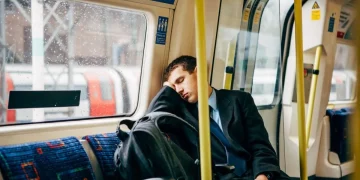










It’s been a long day at work — or a long night out — and as you take your seat on the Tube, you close your eyes for just a moment.
Before you know it, you’re waking up on a section of the Northern line you’ve only ever seen on the map.
The situation is even worse if you’re on a train, and you end up in the wrong county.
At best, it means retracing your steps, at worse, it’s a hefty Uber charge.
The whole sorry tale could have been avoided if a Good Samaritan had given you a nudge — but let’s be honest, how often have you woken up a sleeping passenger on the Tube or a train?
We asked Metro readers for the opinions, and many choose to let sleeping passengers lie — but there’s one exception to the rule.

‘If it was the last stop yes, otherwise, probably not,’ said Brian Oxnard.
Thomas Fluskey agreed, sharing: ‘At the last stop, yes.’
Even a self-confessed train snoozer, Mohamed Motown Hassona, said: ‘As someone who often sleeps on the train, I don’t see why you would wake someone up unless its the last stop.’
Others were of the ‘not my problem’ and ‘don’t get involved’ view, with one saying: ‘I’m obeying the first rule of the Tube: don’t speak to anyone.’
Some readers also some pointed out you can alert train staff, who can do the awkward wake up shove instead.
But those who had been burnt by a train nap, suggested you should wake people up.
Latest London news
- You can now snap up £12 train tickets from London to ‘vibrant’ UK city
- Putney Pusher suspect found dead after being released under investigation
- Buckingham Palace’s hidden treasures uncovered by workmen
To get the latest news from the capital, visit Metro’s London news hub.
Jamz Donovan said: ‘I wish somebody had woken me up on that Piccadilly line train way before I ended up at Heathrow.’
Clea Romeo also had an accidental excursion to the airport: ‘I ended up at Heathrow. It was the last train of the night too!’.
Why does waking up a stranger feel so awkward?
‘We’ve got two versions of being polite arguing in our heads,’ psychologist Stephanie Davies tells Metro.
‘One says: “Leave them alone, don’t interfere.” The other says: “They might need help.”
‘Then we imagine them shouting at us and the entire carriage turning round.
‘Our brains play the story out in our heads and often we picture the worst.’
Stephanie adds that while you might be happy to stand with ‘your nose in a stranger’s airport’, asking if someone is okay, feels too personal.
‘Humans are funny like that,’ she says.
Stephanie notes that gender can play a key role here too, and ‘can change how safe the interaction feels.’
Organisations like Solace Women’s Aid have repeatedly backed initiatives by Transport for London (TfL) to make public transport safer for female passengers.
There was a 10% increase in reported sexual offences on the network in in 2024, and between 2024 and 2025, a five-year high of 595 cases were reported.

Stephanie continues: ‘A woman travelling alone might worry that waking an unfamiliar man will start an interaction she can’t easily get out of.
‘A man waking a woman might worry about frightening her, particularly if touch is involved,’ she explains.
‘Those are real concerns but not rules. Previous experiences, the person’s behaviour, the time of night and who else is around all matter.’
Do you wake up people who fall asleep on public transport?
-
Yes, especially if it's the last stop.
-
No, it's best to leave them alone.
However, Stephanie says, provided you feel safe to do so, ‘noticing each other a bit more’ could do some good.
‘We don’t need to become the self-appointed monitors of the Northern line, but a little kindness towards strangers wouldn’t go amiss,’ she says.
‘Especially in a city where we share so much space and barely acknowledge each other.’
How to approach someone sleeping on public transport
Stephanie shares her tips on how to approach someone who is asleep on public transport, while remaining safe:
- Keep it calm, brief and factual, something like: “Excuse me, we’re at the last stop” or “Sorry to disturb you, are you OK?”.
- Start with your voice rather than grabbing or shaking them (you don’t need to be up in their face), and give them a moment to respond. Make your reason clear. You know you’re trying to help, but someone who’s just woken up doesn’t know that yet.
- Keep it discreet. They’re probably going to feel embarrassed enough without discovering people are exchanging looks and raised eyebrows about them. If they say they’re fine, respect that.
Do you have a story you’d like to share? Get in touch by emailing [email protected]