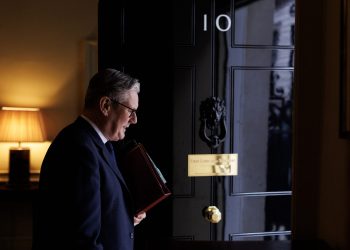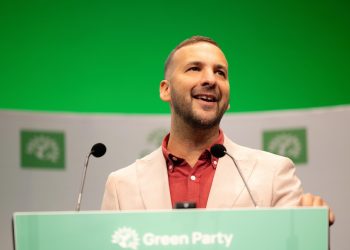


















The leader of the Scottish Labour Party, Anas Sarwar, has moved first.
Declaring that he had to do “what is right for my country”, Sarwar called on the prime minister to resign in a scathing statement.
In a press conference this afternoon, Sarwar proclaimed: “It is not easy and not without pain, but my first priority and first loyalty is to my country… The distraction has to end, and the leadership in Downing Street has to change.”
Sarwar’s sensational intervention marked a massive moment for the politics of the Labour Party and the nation.
Sarwar has felt the blunt force of the Labour brand’s toxicity in his campaign for the upcoming Scottish Parliament elections. That he has chosen to strike now would suggest that the Scottish Labour leader’s estimation of his party’s chances in May is dismal. The intervention is an effective admission that the Scottish Labour Party cannot win an election with Starmer as prime minister.
In July 2022, Sajid Javid, the health secretary, was the first senior party figure to call for Boris Johnson to stand down as prime minister. His resignation was followed mere moments later by that of Rishi Sunak, the chancellor. Javid and Sunak sparked an all-consuming torrent of departures, accompanied by letters lambasting Johnson’s character, judgement and conduct.
In the 24 hours that followed Sunak and Javid’s resignations, 36 MPs stepped down from their roles in government. At the time, Starmer referred to Johnson as a “pathetic spectacle” and mocked those who remained on the frontbench as the “charge of the lightweight brigade”.
Sunak’s resignation was integral in triggering the ministerial stampede that ultimately trampled Johnson. When the herd moves, the outgoing prime minister observed, it moves.
In this regard, the news that Eluned Morgan, the first minister of Wales, would follow Sarwar in calling for Starmer’s resignation initially seemed significant. Like Sarwar north of the border, Welsh Labour is facing a possible routing on 7 May – courtesy of an insurgent Reform UK. But reports have since clarified that Morgan will not be commenting on Starmer’s future today.
***Politics.co.uk is the UK’s leading digital-only political website. Subscribe to our daily newsletter for all the latest news and analysis.***
And so the spotlight now swings back to Westminster.
Sarwar’s statement, together with Tim Allan’s resignation this morning and Morgan McSweeney’s resignation on Sunday, strengthens the prevailing impression of a government in freefall.
But in a strictly processual sense, the Scottish Labour leader has no say in Starmer’s future – that is up to the prime minister himself and the Parliamentary Labour Party (PLP). A leadership contender needs 81 MPs to trigger a contest; meanwhile, Starmer continues to insist that he will not resign.
Responding to Sarwar’s intervention, a Downing Street spokesperson said: “Keir Starmer is one of only four Labour leaders ever to have won a general election.
“He has a clear five-year mandate from the British people to deliver change, and that is what he will do.”
Even more significantly, Sarwar’s declaration has awoken the cabinet from its collective slumber. Downing Street, notwithstanding recent resignations, has been successful in securing public statements of support from secretaries of state.
Rachel Reeves, the chancellor, has insisted that with “Keir as our prime minister, we are turning the country around.”
Darren Jones, the chief secretary to the prime minister, has called on his colleagues to “get behind the prime minister”.
Steve Reed, the housing secretary, has said that Labour needs to “stay the course”.
Douglas Alexander, the secretary of state for Scotland, has said he “respects” Sarwar but that Starmer has his support.
Hilary Benn, the Northern Ireland secretary, has called for “calm heads and seriousness of purpose”.
Peter Kyle, the business and trade secretary, has said he backs Starmer as prime minister, adding: “The economy is growing, let’s focus on delivering for the British people.”
In his first tweet in almost a year, Alan Campbell, the leader of the House of Commons, stated: “The only change we need to be talking about is the change we were elected to deliver for the British people.”
And what of possible leadership contenders?
Ed Miliband, the energy and climate secretary, declared that Starmer has “earned the right to deliver the change he has promised and do what he cares about.”
Wes Streeting, the ambitious health secretary, has conceded that it has “not been the best week for the government.” But speaking to Sky News, he added: “Give Keir a chance.”
On top of this, Angela Rayner has issued a statement saying Starmer has her “full support.” The former deputy prime minister said that the worst possible response to the Peter Mandelson affair would be “to play party politics or factional games.”
These expressions of support, from the enthusiastic to the somewhat strained, matter. So far, Sarwar’s intervention has not provided a springboard to collective action at Westminster; no one has been willing to give a lead at Westminster to an anti-Starmer campaign.
The clean sweep of cabinet support is reminiscent of the reaction to previous Labour coup attempts. In June 2009, after James Purnell resigned as work and pensions secretary and called on Gordon Brown to step down, the rest of the cabinet swung to the prime minister’s defence. David Miliband, the foreign secretary, and Alan Johnson, the health secretary – Brown’s most likely heirs – rowed in behind the Downing Street incumbent.
Purnell’s putsch failed.
In January 2010, two former cabinet ministers, Patricia Hewitt and Geoff Hoon, called for a leadership contest to resolve Brown’s future. The Hewitt-Hoon coup was summarily dismissed by a chorus of cabinet ministers.
There is another possible parallel in recent political history. In January 2022 – some months before Javid and Sunak moved at Westminster – the leader of the Scottish Conservatives, Douglas Ross, called for Boris Johnson to resign as prime minister.
Jacob Rees-Mogg, the then leader of the House of Commons, responded that he did not think Ross was a “big figure”.
Less than two months later, Ross was forced to walk back his call for Johnson to resign.
Then as now, it would seem that the parliamentary party is not ready to depose the sitting prime minister – at least not like this.
Josh Self is editor of Politics.co.uk, follow him on Bluesky here and X here.
Politics.co.uk is the UK’s leading digital-only political website. Subscribe to our daily newsletter for all the latest news and analysis.
The post Reaction to Sarwar suggests Labour isn’t ready to depose Starmer appeared first on Politics.co.uk.