

















In the world of technology, the use of artificial intelligence (AI), robotics and smart devices is growing rapidly. India Mobile Congress (IMC) 2026 also showcased several innovations ranging from simplifying daily life to healthcare, border security and maintaining communication systems during natural disasters. Reliance Jio’s AI smartglasses, kiosks for more than 80 types of health tests, a robot that checks teeth in one minute, an anti-drone security system, an open-arm robot and a PATANG drone providing an emergency network were among the highlights. The purpose of this technology is not only to increase convenience, but also to save time in difficult situations and deliver essential services to people. Let’s explore the features of these six gadgets and how they can be useful.
Jio AI SmartGlass: UPI payments can be made with glasses
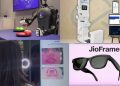
Reliance Jio has introduced AI-based smartglasses, with the idea of facilitating UPI payments. Using this technology it may be possible in the future to make payments without taking out the smartphone every time. Two variants of these smartglasses have been introduced, including an audio-only and a camera model. It also has features like live voice translation. This feature can help facilitate communication between people speaking different languages. The company has not revealed all its technical details and the final price. However, it is said that work is being done to introduce it at an affordable price keeping in mind the Indian customers. If these types of smartglasses are successful in practice, they could change the way digital payments and everyday communication are done.
Curebay Care Kiosk: Over 80 test reports in 30 minutes
To increase the use of AI in the health sector, health tech company Curebay has introduced Care Kiosk. This machine can be seen as a kind of smart health ATM, with the help of which various types of health checks can be facilitated at one place. The kiosk claims to have over 80 types of tests including blood pressure, blood sugar, hemoglobin and liver profile. It analyzes samples with the help of AI and advanced sensors. A digital report can then be obtained on the phone in about 30 minutes. Such a system can be particularly useful in areas where laboratory or healthcare facilities are not readily available. However, it is equally important to know for which tests a kiosk can be used and in which cases conventional laboratory testing is required. This type of technology can be helpful in speeding up initial diagnosis, but it is important to maintain the option of doctor’s consultation and further testing when needed.
Dentist Robot: Dental check-up in just 60 seconds
An AI-based dentist robot has been introduced for primary diagnosis of teeth and gum problems. This robotic dental kiosk analyzes the conditions inside the mouth with the help of advanced cameras, scanning sensors and AI technology. In this system, a person has to sit in front of the machine. Then the inside of the mouth is scanned with the help of camera and robotic arm. It is claimed that the process can be completed in about 60 seconds and the report is visible on the screen. A facility to get the report via WhatsApp has also been featured. This technology can help identify potential problems such as tooth decay, plaque and gingivitis. Due to this, people can get early signs of dental problems and get a chance to contact the dentist on time. However, the report received by AI is not a substitute for final diagnosis. A dental check-up will be necessary as needed to confirm the dental problem and treat it properly.
Dronastra: Security system against enemy drones
Anti-drone technology is increasingly important for securing borders and critical sites. In this direction, an AI-based system called Dronastra has been introduced, which is designed to detect and counter unknown or dangerous drones. The system is claimed to have the ability to identify drones flying in the air with the help of cameras, sensors and AI. It can be used to protect border areas, sensitive locations and critical infrastructure. Technologies for countering drones can include a variety of measures to intercept communication signals, monitor drone movements, or intercept them. The details presented about the drone include signal jamming and the ability to disable drones in mid-air. The main purpose of such a system is to help security forces take action by identifying threats early. However, its exact capacity, functionality and how it is used in different situations depends on the technical details involved.
Qualcomm’s Open Arm Robot: Will Work in Dangerous Places
Technology that can work like a human hand has also become a center of attraction in the field of robotics. The open arm robot introduced by Qualcomm has demonstrated the ability to mimic human hand and arm movements. The robot works using Qualcomm’s chipset and AI platform. Its purpose is to assist in operations where it is difficult or dangerous for humans to do direct work. For example, robotic arms can be useful in hazardous industrial sites, disaster areas, or places where human access is limited. With the help of a robotic arm, operations such as grasping, moving objects and making controlled movements can be possible. The combination of AI and robotics could create new opportunities in future industrial operations and emergency services. However, its actual use will depend on the capabilities of the robot, the control system and the tests performed in the relevant field.
PATANG Drones: To create emergency network in times of disaster
If the mobile network is disrupted during a natural disaster, communication between rescue operations and the public can become difficult. Considering this problem, a drone named PATANG has been introduced by Asteria Aerospace, a company of Reliance Industries. These drones can be used to maintain communication systems during disasters like floods, earthquakes and hurricanes. Airborne drones are intended to provide an alternative communication system if a mobile tower is damaged or the network is down in an area. PATANG is mentioned to have features like communication tools and 4K camera. A system that allows drones to hover around a single area for long periods of time can help maintain contact between rescuers and affected people. Camera can also be used to monitor the condition of the affected area.
This type of technology can be useful in disaster management, as a functioning communication system can make it easier to coordinate rescue operations, locate people in need, and deliver aid. However, the reach and efficiency of the network will depend on the area, weather and technical capabilities of the drone. These six technologies presented at the India Mobile Congress 2026 show that the use of AI, smart devices, robotics and drones is no longer limited to mobiles or computers. From digital payments to health screening, border security and disaster communications, its use is likely to grow. However, some of these features may still be in the introduction or development stage. So we will have to wait for more details from the companies to know when it will be available to the general public, how much it will cost and how it will perform in actual use.