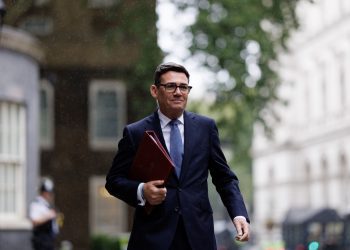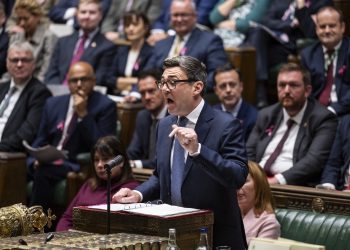











Andy Burnham entered Downing Street in July vowing to reverse the “wrong turns” of British statecraft over the past 40 years. He cast his new administration as a “circuit breaker”, promising a programmatic antidote to deindustrialisation, regional inequality and popular disaffection – the damage wrought on the body politic by decades of neoliberalism.
The budget delivered by chancellor John Healey last week was competent, and in parts clever. Its 98 measures – a record number of policy interventions by recent standards – demonstrated political dexterity while conveying a broad indication of the direction in which the government hopes to travel. It was consistent with the Burnham government’s emerging identity, particularly its commitment to an interventionist state as a means of restoring public faith in government. The budget’s centrepiece – a one-off £100 payment to around 20 million households in council tax bands A to D – epitomised this approach. This was another “breathing space” measure designed to persuade an impatient public that government is attentive to everyday frustrations and trying to make a difference.
There was also a faintly populist dimension to the budget. Gambling companies, banks and vape shops were identified as sources for revenue. Healey presented the temporary increase in the bank surcharge as a repayment of sorts: the public helped support the banks during the financial crisis, and now the banks should help support families. This wise choice of budget enemies contrasts favourably with Labour’s first fiscal package in October 2024, which infuriated farmers, employers and pensioners.
Whatever its political merits, however, the budget fell well short of the economic rupture promised by Burnham’s analysis. No single fiscal event could reasonably be expected to dismantle the dominant assumptions of British economic policy. But the narrow course charted by Healey last week is highly revealing of the constraints bearing down on the government.
Intriguingly, the prime minister has himself given weight to this assessment. “The room for manoeuvre wasn’t what I would have hoped it to be”, Burnham told ITV in a sit-down interview. He argued that the budget was “radical within what we were able to do.”
Pointing to geopolitical developments, the prime minister suggested that “the volatility of things means that you can’t necessarily deliver the budget that, in an ideal world, you would want to deliver”.
Burnham was also asked about the extent to which he feels “hemmed in” by Labour’s 2024 manifesto. “If I had held the pen on the current Labour manifesto, would I have written it exactly like it is”, he responded. “Well, no is the answer.”
Burnham’s answer acknowledges an inconvenient truth: the boundaries within which his government operates are defined by a document that he had no hand in drafting.
This is a political problem for which there is no obvious resolution.
Burnham could renege on his recent pronouncements and call a general election, presenting his own programme to the country. But a snap poll would carry considerable risks. The prize of a personal mandate for Burnhamism must be weighed against the prospect of substantial losses. Labour’s recovery under Burnham has been uneven, with the party still needing to make up ground in Wales and Scotland. Moreover, the prospect of a hung parliament could end up imposing further constraints by virtue of a covenant with Ed Davey and the Liberal Democrats.
In September, Burnham said an early election would be destabilising and “backward-looking”. He senses that an impatient public would rather Labour got on with governing. Indeed, however compelling the political case for an election, making the argument that a snap poll is in the national interest – as Theresa May found in 2017 – is considerably more problematic.
Theresa May’s election gamble backfires, resulting in hung parliament
An early election would also require Burnham to turn the broad direction of travel – vibes – into a fully costed and politically defensible offer. This would mean resolving questions that his government has only just begun to address, or has so far been able to defer. For instance, a campaign would demand a coherent position on Europe – on a future referendum, on the customs union, the single market or rejoining the EU in full. Burnham’s decision to open the debate on Europe has demonstrated considerable confidence, but also latent divisions in Labour ranks. An election with a view to securing a new mandate surely would mean revisiting Labour’s restrictive tax commitments, as defined by its 2024 manifesto. How voters would react to Labour loosening those pledges is hard to judge, but the risks are plain – especially if the Conservatives enter the campaign from a position of strength.
For now, the government appears to have settled on an interim strategy. Burnham has increasingly adopted the posture of a de facto opposition force, using commissions, consultations and committees to prepare the ground for a new settlement, while issuing tactical interventions to make short-term progress in the current mould. Speaking to ITV, Burnham was relatively candid about this approach. “I’m in the position where I want to lay out what a good 10-year plan looks like for the country, make a start on it, and then at the right moment seek a mandate to deliver it in full”, he said.
But the risks of this strategy are all too apparent. The longer Burnham governs within the guardrails set by the 2024 manifesto, the harder it may become to distinguish his administration from the one it replaced. So long as Labour’s legitimacy rests on that platform, according to his own analysis, he remains in hock to a discredited status quo.
Burnham has demonstrated that he can govern differently in presentation, priorities and political instincts. But his wholesale rejection of the prevailing orthodoxy risks overselling Labour’s ability to chart a new course, opening a gap between what voters expect and what his government can deliver.
Britain leaves the European Union after 47 years of membership
There is a further danger. A government operating under these constraints can become preoccupied with the ingenuity required to work around them. Political energy is spent finding interventions that fit within a narrow framework, rather than confronting the deeper problems that the framework itself perpetuates. The government risks losing its sense of agency, becoming increasingly adept at navigating the limits of its inheritance – but less able to challenge them.
This is the difficulty at the heart of Burnham’s premiership. He has challenged, forcefully, the terms of the political debate without yet changing the terms on which he can govern. The budget has bought him some breathing space, but not resolved this underlying tension.
Something, at some point, will have to break: the manifesto, the timetable for an election or the ambition itself. The extent to which Labour can find a sustainable resolution to this dilemma will determine Burnham’s fate.
The post Andy Burnham needs more than ‘breathing space’ appeared first on Politics.co.uk.