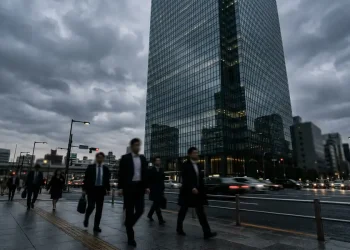











Stock markets across Asia closed out their worst week since the early days of the Covid-19 pandemic on Friday, as a sharp retreat from technology shares swept through the region’s chip-heavy exchanges.
The sell-off came a day after Anthropic, the developer of the Claude AI models, made its debut on the Nasdaq in New York. The listing had been expected to restore some confidence in the AI trade. Instead, analysts said, it appeared to pull money away from established AI stocks and sharpen questions about whether the industry’s spending can ever be repaid.
A brutal Friday from Tokyo to Taipei
Japan’s benchmark Nikkei 225 fell 5.1% on Friday, while South Korea’s Kospi dropped 5.2%, Al Jazeera reported. Taiwan’s Taiex plunged 6.2% and Hong Kong’s Hang Seng closed 1.9% lower.
According to Reuters, MSCI’s broadest index of Asia-Pacific shares was on course for a weekly fall of around 7%, its weakest performance since March 2020, with Taiwanese shares heading for their biggest weekly decline since 1990.
Japan’s SoftBank Group, one of the largest backers of OpenAI, bore the brunt of the selling. Its shares closed 14.48% lower, their worst day since August 2024, CNBC reported. The group has invested a total of $64.6bn in the ChatGPT maker, and its stake in the British-born chip designer Arm has made it especially sensitive to swings in AI sentiment. SoftBank’s shares lost 30% in October and are down 31% so far this month.
Chip-equipment makers were also hit hard. Tokyo Electron fell 7.06%, Lasertec 9.21% and Renesas Electronics 7.02%. In Seoul, the Nvidia suppliers SK Hynix and Samsung Electronics dropped 5.92% and 7.01% respectively, while TSMC closed 4.76% lower in Taiwan.
Why Anthropic’s listing did not lift the mood
Anthropic raised $81.3bn in what is the largest initial public offering on record. Its shares opened at $111.50 on Thursday before settling just above $97, but the wider market moved the other way. On Wall Street, the Nasdaq Composite fell 2.3% and the S&P 500 dropped 2% that day.
Carlos Casanova, senior economist for Asia at Union Bancaire Privée in Hong Kong, told Al Jazeera that the sell-off reflected a “collapse in confidence in the AI investment thesis”. He said: “Rather than lifting the broader AI complex, the listing appears to have diverted liquidity from established AI plays as investors rotated into the new issue.”
Kyle Rodda, senior financial market analyst at Capital.com, told Reuters that “Anthropic’s blockbuster IPO proved not enough to assuage the overall concern about the outlook for the AI trade and equities more broadly.”
Other pressures are piling up. Washington this week announced new licence requirements aimed at stopping Chinese AI developers from remotely using advanced computing power in data centres abroad, mainly in South-East Asia. Investors are also weighing a likely US interest rate rise next month, and the dollar has climbed to its strongest level since April 2025.
India bucks the trend
One major Asian market went in the opposite direction. India’s Sensex rose 1.08% on Friday to close at 83,919.71, and the Nifty gained 1.12% to 25,800.60, both at nine-month highs, The Economic Times reported. Analysts said foreign funds were moving out of AI-linked markets and into Indian banks and IT services, which have less direct exposure to the chip cycle.
What it means for UK readers
The turmoil matters well beyond Asia. Many UK pension funds, ISAs and tracker funds hold large positions in global technology companies, either directly or through index funds that are heavily weighted towards AI-related shares. A sustained slide in chipmakers and AI investors would feed through to the value of those savings.
Cambridge-based Arm, which is majority-owned by SoftBank, is closely tied to the sector’s fortunes, and several large UK-listed investment trusts hold stakes in Asian chipmakers such as TSMC and Samsung. Savers with emerging markets or Asia-Pacific funds are likely to see this week’s falls reflected in their next statements.
There may be a small benefit for consumers. If demand for chips and data-centre equipment cools, pressure on component prices could ease, although any effect on the price of phones and laptops in UK shops would take months to show.
What happens next
Investors will watch whether Friday’s losses carry into next week, and whether Anthropic’s own shares can hold on to their early gains.
Analysts also flagged the risk of further US restrictions on chip exports and the impact of any rate rise from the Federal Reserve in December. Rajat Agarwal, an Asia equity strategist at Société Générale, told Al Jazeera that the key question was “how long can the domestic investors stay put” while foreign buyers are absent, particularly in South Korea, where he said the drawdown has been more severe.
For now, the message from the region’s trading floors is that the market wants evidence that the trillions being spent on AI will produce profits, not just more spending.