








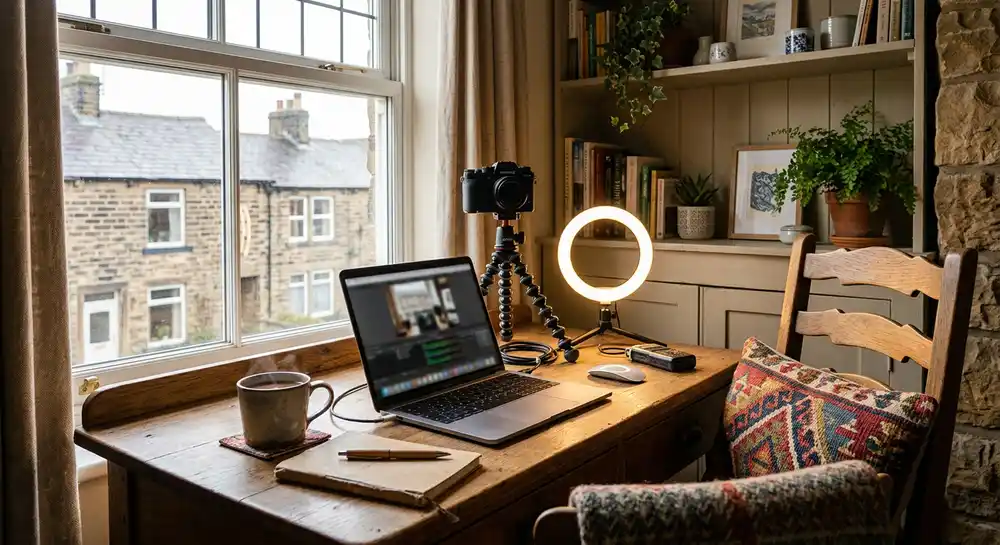
A British-Pakistani woman from Bradford who was diagnosed as autistic at the age of 42 has launched a YouTube channel in Urdu to help South Asian families understand the condition.
Hina Shaikh told BBC News that after her diagnosis she searched online for videos to help explain autism to her mother in Urdu, but could not find any. So she decided to make them herself.
“The aim is to kind of engage with the South Asian community who is so reluctant to actually recognise autism,” she said.
A late diagnosis
Ms Shaikh says she grew up feeling “quirky or different or weird” in a British-Pakistani family, without understanding why. She finds the feeling of flour on her hands overstimulating, which made making chapatis, a staple of family cooking, almost impossible.
She put some of her sense of difference down to her background. Most families of Pakistani heritage in Bradford trace their roots to Mirpur and speak Punjabi, while her family is from Karachi and speaks Urdu. But even within her own culture, she said, she knew she was different.
The suggestion that she might be autistic came from an unexpected place. While working as a car salesperson in her 40s, she sold a car to a man who turned out to be a social worker specialising in neurodiversity. He asked whether she might be autistic. A Guardian feature on autism earlier this month, which also told her story, reported that he had noticed details such as how she avoided small talk and how neatly her pens were lined up on her desk.
After being told there was an 18-month NHS waiting list for an adult assessment, she paid for a private clinic and was diagnosed.
“It’s the system, not the culture”
Ms Shaikh does not blame her community for the missed diagnosis. She went to school in the 1980s and 1990s, when, she said, quiet and obedient children who got good grades were rarely picked up. “So, they would have never really picked up on it,” she told the BBC.
She believes many women in their 30s, 40s, 50s and even 60s are now being diagnosed after years of having their symptoms missed. “They’ve led a life that could have been so different if they’d just known that they were autistic,” she said.
She is concerned that older generations of South Asians still see autism in narrow terms. “We are seeing a shift in South Asians, especially the ones that are educated,” she said. “But then we still have a generation that don’t understand it. It’s still very new to them.”
Her videos, published under the name “Hinayas: The Desi Autistic”, aim to show that autistic people can lead full lives. “Me being autistic, I can still lead a life that is very normal,” she said. “It doesn’t make me any less just because I’m different.”
The wider picture
Autism diagnoses in England have risen sharply in recent years. According to Department of Health and Social Care figures cited by the BBC, autism-related special educational needs in schools rose from 1.5% of pupils in 2016 to 3.3% in 2024. A government review published in October found that much of the increase in diagnoses was because many people had previously gone undiagnosed.
Campaigners have long warned that families from ethnic minority backgrounds face extra barriers, from language and a lack of culturally relevant information to stigma and fear of being judged. The DESIblitz website, which also covered Ms Shaikh’s launch, noted that she hopes to fill a gap in content aimed at British Asians.
What it means for UK readers
Urdu and Punjabi are among the most widely spoken languages in England after English, and Bradford has one of the largest populations of Pakistani heritage in the country. Information in community languages can make a real difference to whether parents seek an assessment for their child, or whether older relatives accept a diagnosis in the family.
For British Asian adults who suspect they may be autistic, Ms Shaikh’s story is also a reminder that a diagnosis is possible later in life. The NHS route usually begins with a GP referral, although waiting times vary widely across the country.
What happens next
Ms Shaikh says she wants to raise awareness “in a positive light” and to provide the kind of role model she could not find. “When I was diagnosed autistic, there wasn’t anybody that was an adult who was autistic, who I could follow in terms of vlogs or anything like that,” she said.
The National Autistic Society offers information and support for autistic people and their families, including advice on seeking a diagnosis.