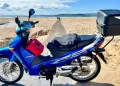













I sat hunched over the handlebars, willing the scooter to keep climbing. Every bend revealed another ascent, each steeper than the last, and I was running out of gears. As the Honda finally wheezed to the top, I couldn’t stop grinning. Surely this step-through scooter was designed for delivering takeaways, not crossing countries?
The ride to Spain had started as an idea hatched in the pub. Two friends and I had ridden a variety of motorcycles over the years, though never on particularly lengthy journeys, and certainly not machines with close to snail-like performance. We wanted a long-distance adventure, though, and with tight travel budgets, we devised a plan to keep costs down. A “proper” bike would have shrugged off the miles with ease, but where’s the fun in that?
Instead of spending somewhere in the region of £20,000 each on towering motorbikes with adventure styling and aluminum panniers, we would invest in three aging Honda ANF125 scooters.
Mine cost just £600 and had delivered kebabs and pizzas on the Dorset coast. It came with a rack, so all I needed was a second-hand top box and a set of eBay panniers and I was away.
We had no route mapped out, no accommodation booked and no itinerary to speak of. Setting off from home in Dorset, we took the ferry from Poole to Cherbourg, after which our only rule was simple: keep the sea on our right, because that would mean we were going the right way. We’d booked a flexible ferry ticket back to the UK from Santander 10 days later.
With the bikes producing single-digit horsepower, we had a comfortable cruising speed of just 40-45mph – but that was partly the point. It meant we simply couldn’t rush. There was no blasting past scenery or hammering down motorways to clock up miles.
By avoiding major roads and choosing quieter routes better suited to our machines, we noticed everything: sleepy villages, coastal roads, bakeries opening in the morning and cafes full of locals staring in disbelief as three tiny scooters buzzed past, loaded up with camping gear.

With no fixed schedule, we could stop whenever something looked interesting. One afternoon in the French town of Escource southwest of Bordeaux – somewhere we’d have whizzed past without noticing on a dual-carriage motorway – we spotted a small roadside restaurant and decided, on a whim, to stop for lunch.
We ended up eating steak in a rich cheese sauce while chatting to the owner, who had previously lived in the UK and spoke excellent English.
At first, she thought something had been lost in translation and assumed “scooter” meant “motorcycle”. When she realized what we were riding, and that we’d ridden them all the way from the UK, heading for Spain, word spread around the restaurant.
By the time we left, diners and staff had gathered outside to wave us off as though we were embarking on some heroic expedition rather than wobbling south on aging delivery bikes.

That reaction became a recurring theme throughout the trip. Other motorcyclists would often assume we’d unloaded the scooters from the back of a van nearby and were visibly staggered when we explained how far we’d ridden them.
Ticking “avoid tolls” and “avoid motorways” on Google Maps was surprisingly effective, leading us through sleepy villages and past farmers tending their fields. Not knowing where we’d be staying each night added an element of jeopardy.
We figured traveling in September and avoiding the summer rush would guarantee campsite availability – a theory that worked like a charm at our first campsite in Bricqueville sur Mer. We found the place online, and tent pitches cost just €10 each.

However, an unseasonably warm front breezed across France one weekend, filling campsites in a flash. Having uttered “Désolé, c’est complet”, the reception staff at a site near Pornic glanced at us – three men of a certain age – and our unsuitable machines, before offering us the garden of a chalet under construction. The step-through scooters had worked their magic.
There were moments where our judgment felt questionable, though. We tackled mountain roads we had absolutely no business attempting and rode through biblical rainstorms that left us drenched to the skin.
A soaking shortly after we’d crossed into Spain made us reassess our choice of accommodation, and we booked a chalet in seaside Deba, west of busy San Sebastián, for €75 each. Big money compared to our average daily costs, but worth it to avoid a soggy night under canvas.
On the flip side, there were empty coastal roads, €2 supermarket wine and the kind of unpredictable experiences that rarely happen when every hotel and route is booked months in advance.

In northern Spain, we again kept the sea to our right as we headed towards Santander before boarding the 22-hour ferry to Plymouth. We returned home with mildly aching derrieres, convinced that adventure motorcycling needn’t cost the earth – all it needs is a softer saddle.
The trip – all eight days and 915 miles (800 to Spain plus 115 back from Plymouth) – cost me less than £2,000, including fuel, accommodation, food and drink, ferries and the scooter itself.
The humble Honda has a claimed fuel economy of 175.8 miles per gallon, helping keep costs low, although the weight and aerodynamic impact of the top box and panniers undoubtedly ate into this figure.
Most importantly, however, the journey completely reframed what adventure means. It’s not about the machine, the mileage or the Instagram aesthetic. It’s about the willingness to go. At a time when big-ticket hobbies might feel out of reach, there’s perhaps a growing appeal in a different kind of adventure: slower, cheaper, less polished – but arguably far more memorable.